





Bidirectional vs Hybrid Inverters: Key Differences
- Understanding inverter roles in modern PV and storage systems
- What each inverter type does
- How hybrid inverters are positioned
- Standards and interoperability
- Technical differences: power electronics, control and topology
- Power-stage topology and bidirectionality
- Control strategies and modes
- Efficiency and losses
- Applications, installation considerations and sizing
- When to choose a bidirectional solar inverter
- When a hybrid inverter may be preferable
- Sizing and configuration checklist
- Performance comparison and compliance
- Feature comparison table
- Regulatory and certification considerations
- Empirical performance and lifecycle costs
- Real-world selection: decision matrix and recommended workflows
- Decision matrix
- Workflow for specifying an inverter
- Installation best practices
- Industry context and vendor selection — including Guangzhou Congsin Electronic Technology
- Market maturity and supplier considerations
- About Guangzhou Congsin Electronic Technology Co., Ltd.
- How Congsin’s offerings map to bidirectional and hybrid needs
- FAQs
- 1. What exactly is a bidirectional solar inverter?
- 2. Are hybrid and bidirectional inverters interchangeable?
- 3. Which is more efficient: bidirectional or hybrid?
- 4. Do I need special certification for exporting power if I use a bidirectional inverter?
- 5. Can I retrofit an existing PV-only system to add battery storage?
- 6. How does the battery management system (BMS) interact with bidirectional inverters?
- Contact and next steps
I’ve worked with solar-plus-storage systems and utility-interactive power electronics for years, and one recurring question I see from integrators and end users is how a bidirectional solar inverter differs from a hybrid inverter. This distinction matters for system architecture, control strategy, certification and lifecycle costs. In this article I summarize the key technical differences, performance impacts, compliance considerations and application scenarios, so you can choose the right topology for your project.
Understanding inverter roles in modern PV and storage systems
What each inverter type does
A bidirectional solar inverter is primarily designed to convert DC to AC and AC back to DC with high efficiency and controlled power flow between an AC grid and a DC battery bank. Its central feature is the ability to charge and discharge batteries using the same power electronics stage, often enabling fast, seamless control of charge/discharge cycles and support for vehicle-to-grid (V2G) or grid-following/grid-forming functionality. The term bidirectional solar inverter emphasizes that the inverter actively manages both AC export/import and DC storage flows.
How hybrid inverters are positioned
Hybrid inverters combine PV inverter functions with integrated battery charging controllers and often include an internal transfer switch for backup operation. A hybrid inverter is typically marketed as an all-in-one solution that manages PV generation, battery storage and AC loads. In many products the battery interface may be handled by a dedicated DC-DC stage or charge controller inside the unit, or via an internal battery inverter stage that’s optimized for integrated operation.
Standards and interoperability
Understanding standards is important: IEEE 1547 defines interconnection requirements for distributed energy resources and impacts inverter anti-islanding and ride-through behavior (IEEE 1547-2018). Grid codes and local regulations will affect your inverter selection, especially when the device must export to or operate independently from the grid.
Technical differences: power electronics, control and topology
Power-stage topology and bidirectionality
Technically, a bidirectional inverter implements a power stage that is symmetrical in energy flow: the AC-DC and DC-AC conversions are handled by inverter stages capable of both rectification and inversion. This often requires high-performance semiconductor switching, synchronous control and careful thermal design to maintain round-trip efficiency. Hybrid inverters may present a similar hardware footprint but sometimes include separate DC-DC converters for battery management, which can introduce additional conversion steps.
Control strategies and modes
Bidirectional inverters are often optimized for dynamic control—fast charge/discharge transitions, reactive power support and participation in grid services (frequency response, VAr control). Hybrid inverters prioritize seamless PV-battery-load coordination, backup transfer timing and simplified user interfaces. Which control features matter depends on whether you need grid support functions or a resilient islanding capability.
Efficiency and losses
Round-trip efficiency depends on topology. A single-stage bidirectional inverter that handles DC↔AC in one optimized stage can achieve better round-trip efficiency (typical DC-coupled systems with a single power stage can reach 95–98% peak inverter efficiency) compared to solutions with separate DC-DC battery converters plus PV inverter, which add stage losses. For grid-tied PV plus battery, the difference can be 1–3 percentage points in real-world conditions. For technical background on inverter efficiency ranges see the U.S. Department of Energy solar inverter overview (energy.gov).
Applications, installation considerations and sizing
When to choose a bidirectional solar inverter
I recommend a bidirectional solar inverter when the primary goal is optimal battery cycling performance, fast grid-support capabilities, or when you need V2G/V2H functions. For large battery systems, commercial energy storage or systems that must provide frequency/voltage support, the bidirectional topology provides the flexibility and efficiency required.
When a hybrid inverter may be preferable
Hybrid inverters excel in residential or small commercial installations where turnkey simplicity, integrated battery management and backup functionality are priorities. If you want a compact solution with fewer components, simplified commissioning and integrated transfer for emergency power, a hybrid inverter is often the practical choice.
Sizing and configuration checklist
Key questions I use when sizing and specifying are:
- Will the system export to the grid, or is it primarily off-grid/backup?
- Do you need fast ramping or grid ancillary services (frequency response, VAr control)?
- What are the battery chemistry, nominal voltage and BMS communications requirements?
- Are you constrained by space, budget, or certification requirements?
Performance comparison and compliance
Feature comparison table
| Feature | Bidirectional Inverter | Hybrid Inverter |
|---|---|---|
| Primary strength | High-efficiency DC↔AC bidirectional flow, grid services | Integrated PV + battery management, backup-ready |
| Topology | Single-stage or symmetrical power stage | PV inverter + internal/external DC-DC battery charger |
| Round-trip efficiency | Typically higher (95–98% at optimal points) | Variable; may be slightly lower due to extra conversion steps |
| Best use case | Commercial energy storage, V2G, grid support | Residential PV+storage, off-grid with simple management |
| Complexity | Higher controls complexity, advanced communication | Simpler installation and user experience |
Regulatory and certification considerations
Both inverter types must comply with local grid codes; for systems exporting to utility grids you should verify IEEE 1547 compliance or the equivalent standard applicable in your region (IEEE 1547-2018). For product quality and factory processes, ISO9001 certification is a marker of consistent manufacturing quality (ISO 9001).
Empirical performance and lifecycle costs
When I model lifecycle costs, I include capital costs, inverter efficiency losses, battery cycling degradation and maintenance. Higher round-trip efficiency reduces effective energy throughput and can extend battery lifetime indirectly by reducing unnecessary cycles. For technical literature on inverter designs and performance metrics, research papers and whitepapers hosted by national labs like NREL provide measured and modeled comparisons (NREL).
Real-world selection: decision matrix and recommended workflows
Decision matrix
To simplify selection, I use a decision matrix that weights critical factors: export requirement, backup needs, efficiency priority, ease of installation, and budget. Here’s a typical scoring guideline I apply:
| Factor | Weight | Prefer Bidirectional | Prefer Hybrid |
|---|---|---|---|
| Grid services / export | 25% | High | Low |
| Backup simplicity | 20% | Medium | High |
| Efficiency priority | 20% | High | Medium |
| Installation cost & footprint | 20% | Medium | High |
| Integration complexity | 15% | Higher | Lower |
Workflow for specifying an inverter
- Define energy flows: expected PV production, battery rounds, export/import limits.
- Determine control needs: grid-forming vs grid-following, islanding time, VAr support.
- Assess battery interface: voltage, BMS communication (CAN/RS485), charge limits.
- Compare product datasheets: continuous/peak power, efficiency curves, certifications.
- Model lifecycle cost and payback including net metering or export tariffs.
Installation best practices
Whether you choose a bidirectional solar inverter or hybrid inverter, follow best practices: separate AC and DC conduits where possible, protect DC cabling with appropriate fuses, ensure BMS interoperability and perform commissioning tests including anti-islanding and protective relay coordination. Documentation from regulators and standards bodies should guide protective settings (IEEE 1547).
Industry context and vendor selection — including Guangzhou Congsin Electronic Technology
Market maturity and supplier considerations
Market maturity varies: residential hybrid inverters are widely available from many consumer-facing brands, while high-performance bidirectional inverters are more common in commercial and utility-scale energy storage markets. When evaluating suppliers, check factory certifications, long-term warranty policies, and OEM/ODM capabilities if you require customization.
About Guangzhou Congsin Electronic Technology Co., Ltd.
Guangzhou Congsin Electronic Technology Co., Ltd., founded in early 1998, is a professional power inverter manufacturer with over 27 years of focused experience. We design, R&D and manufacture a wide range of power solutions—with a core emphasis on DC→AC power inverters, portable power stations, and solar charge controllers. Our catalog includes 100+ models tailored for vehicles, solar systems, RVs and trucks, off-grid homes, outdoor offices, patrol and field construction work.
We operate fully automated production lines, advanced instrumentation and multifunctional testing equipment to ensure product reliability, efficiency and intelligent functionality. Environmental and safety compliance are built in: our quality system is ISO9001 certified and many products hold international approvals such as CE, EMC, LVD, ETL, FCC, RoHS and E-MARK. Several independently developed patents further demonstrate our commitment to innovation.
Congsin’s products serve global markets across Europe, the Americas, the Middle East, Africa and Southeast Asia; many models are supplied to domestic and international OEM channels. Our support includes OEM/ODM, private labeling, distribution and bespoke customization to meet partner specifications. Our mission is to deliver reliable, efficient and affordable energy solutions that enable energy independence.
How Congsin’s offerings map to bidirectional and hybrid needs
From my evaluation of product lines and factory capabilities, Congsin’s range supports both hybrid residential solutions (integrated PV+battery units and portable power stations) and DC→AC inverter products suitable for custom bidirectional implementations. For buyers seeking OEM/ODM, Congsin’s integrated production and ISO9001 quality system provide advantages in consistent quality and rapid iteration of customized functions like BMS interfaces and grid support features.
FAQs
1. What exactly is a bidirectional solar inverter?
A bidirectional solar inverter is a device capable of converting DC to AC for powering loads or exporting to the grid, and converting AC back to DC to charge batteries, using the same power electronics stage or tightly integrated stages. It’s designed for reversible energy flow and often supports advanced grid services and V2G/V2H applications.
2. Are hybrid and bidirectional inverters interchangeable?
Not always. While some hybrid inverters offer bidirectional flows (charge/discharge), the control granularity, efficiency and grid-service capabilities may differ. Check datasheets and control features rather than relying on marketing labels.
3. Which is more efficient: bidirectional or hybrid?
Pure bidirectional topologies with a single optimized power stage often yield marginally higher round-trip efficiency (commonly in the 95–98% range under ideal conditions) compared with setups that include an extra DC-DC conversion stage. Real-world efficiencies depend on operating point and manufacturer design. For inverter basics see Wikipedia.
4. Do I need special certification for exporting power if I use a bidirectional inverter?
Yes—exporting power typically requires compliance with local grid interconnection standards (e.g., IEEE 1547 in the U.S.) and utility-specific requirements. Verify inverter certifications and grid interconnection studies during project design (IEEE 1547).
5. Can I retrofit an existing PV-only system to add battery storage?
Often yes. Options include adding a hybrid inverter designed for retrofit or adding a bidirectional inverter paired with a compatible battery and BMS. Retrofit success depends on existing string inverter architecture, AC-coupled vs DC-coupled choices and space for additional equipment.
6. How does the battery management system (BMS) interact with bidirectional inverters?
Bidirectional inverters typically require communication with the BMS (via CAN, RS485, Modbus, etc.) to respect battery SOC, voltage, current limits and safety interlocks. Ensure compatibility and validated communication protocols for safe operation.
Contact and next steps
If you’re specifying a system and want input on whether a bidirectional solar inverter or a hybrid inverter fits your project, I can help review energy flows, grid requirements and product choices. For product inquiries, OEM/ODM partnership or to view Congsin’s product catalog including Solar Charge Controllers, modified sine wave inverters, pure sine wave inverters and portable power stations, contact Guangzhou Congsin Electronic Technology Co., Ltd. through their official channels or request a quote and technical datasheets. Choose the right inverter architecture to optimize efficiency, compliance and long-term value.
Contact us to discuss your system design or request detailed product specifications and OEM customization options.
High Frequency Inverter Buying Guide for Industrial Applications
MPPT vs PWM: Which Solar Charge Controller to Buy

12 Best Solar Inverters for Home in 2026: Expert Reviews & Comparison Guide
How to Size a 2000W Inverter for Home Backup and Appliances
Products
Can I customize the logo?
Yes, OEM/ODM service is available.
Pure Sine Wave Inverters
Can the 3 AC sockets drive high-power devices at the same time?
Yes, but it is necessary to ensure that the total power of the 3 devices does not exceed 2000W (continuous power). For example, it can drive 1 1000W electric oven + 1 500W microwave + 1 400W printer at the same time (total power 1900W), avoiding total power overload to trigger the protection mechanism.
What is the reason for the inverter automatically shutting down during operation?
It is likely that the protection mechanism is triggered: 1. Load overload (total power of connected devices exceeds 1000W); 2. Abnormal input voltage (battery voltage <10.8V or >14.5V); 3. Device overtemperature (excessively high ambient temperature or cooling fan failure). It is recommended to disconnect some loads, check the battery voltage or clean the heat dissipation port before trying again.
Modified Sine Wave Inverters
Can I customize the color and logo?
Yes, OEM/ODM customization is supported.
Is it a pure sine wave or a modified sine wave? What's the difference?
This is a modified sine wave inverter, suitable for most conventional home appliances and electronic devices; pure sine wave is suitable for precision devices with extremely high power requirements. This modified sine wave is more cost-effective at 2000W, meeting the needs of most scenarios.
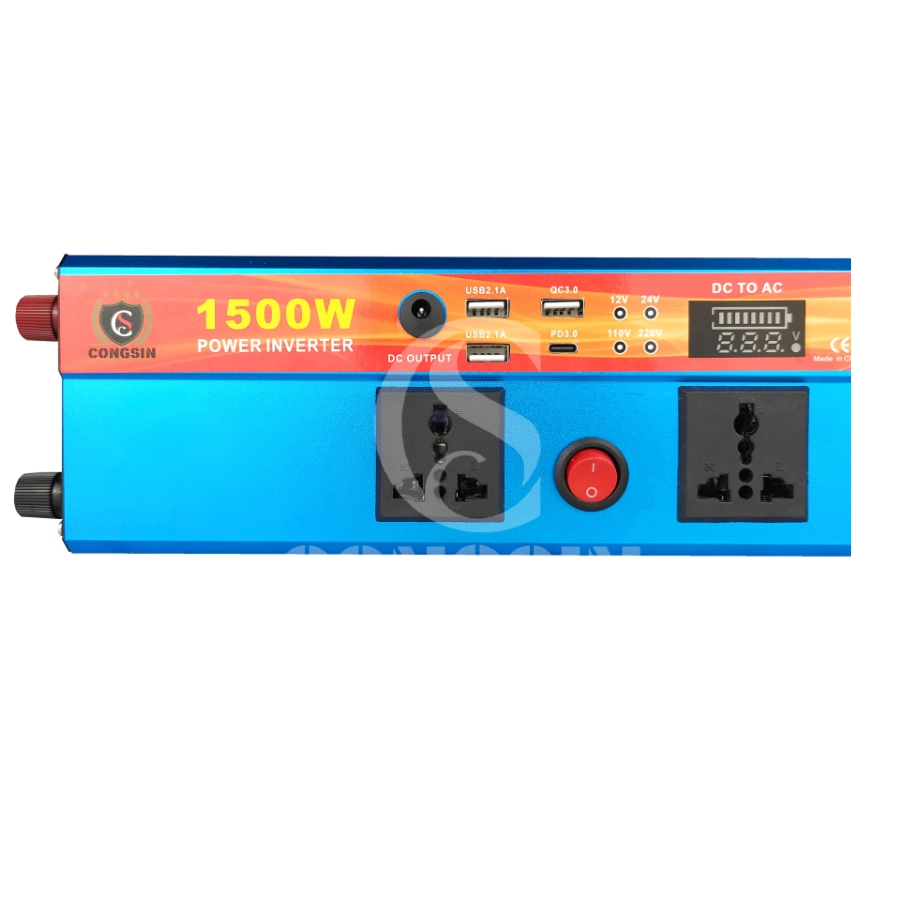
1500W Modified Sine Wave Inverter, DC 12V to AC 220V Power Inverter with LED Display, 3 USB Ports, 1 Type-C, 1 DC 12V Output & Two Universal Sockets
Our CS1000DDBC 1000W modified sine wave inverter is a professional power conversion device that converts DC 12V from batteries into AC 220V electricity. It is designed with user convenience in mind, featuring an LED display for real-time status monitoring, multiple charging ports (3 USB, 1 Type-C, 1 DC 12V) and two universal sockets to power a wide range of devices simultaneously. Its compact size (250×95×55mm) and lightweight design (NW: 0.84kg) make it easy to carry, ideal for outdoor activities, emergency home use, and on-the-go power needs.
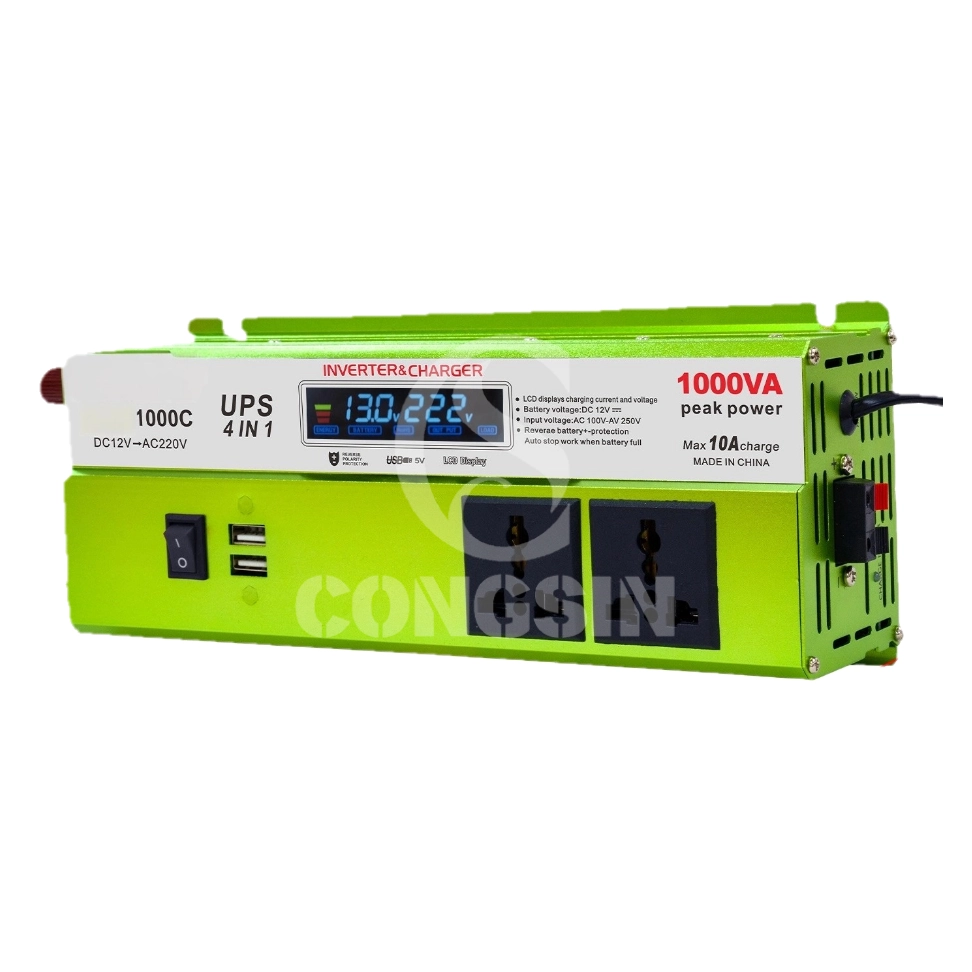
1000W 1500W 2000W UPS POWER INVERTER WITH CHARGER 10A 15A 20A DC TO AC 12v24v 110v 220V
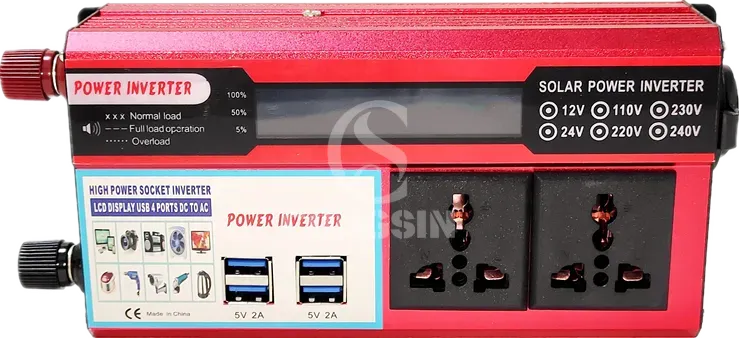
Congsin 500W Modified Sine Wave Inverter with LCD Display of Off Grid System Solar Power Inverter
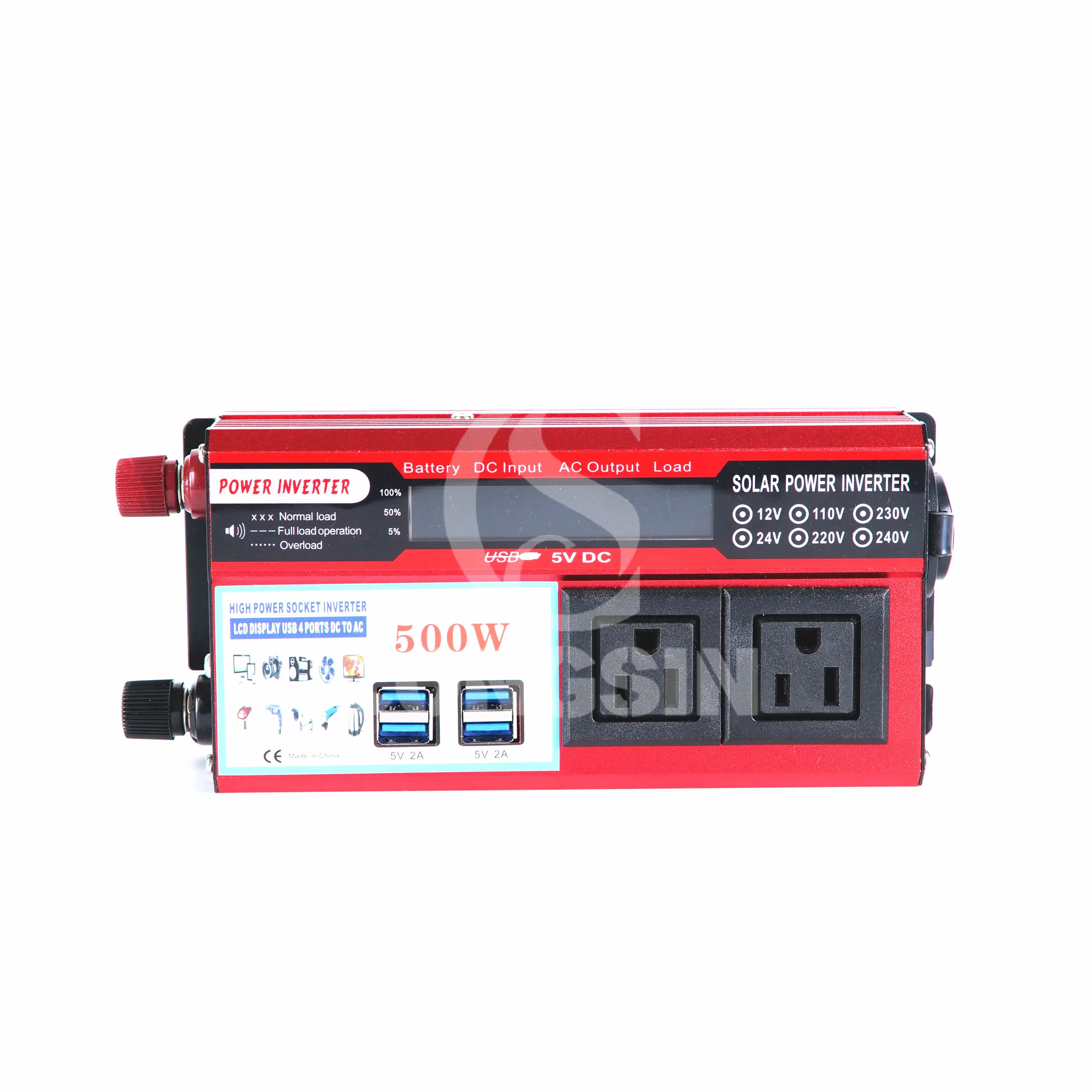
Congsin 500W modified sine wave power inverter US sockets 4 USB ports LCD display off grid

CONGSIN is a trusted OEM factory for power inverters, solar charge controllers, and DC converters. Reliable solutions for global B2B buyers.
 High Quality
 7/24 Service
 Guaranteed Warranty
© 2025 Congsin. All Rights Reserved.